
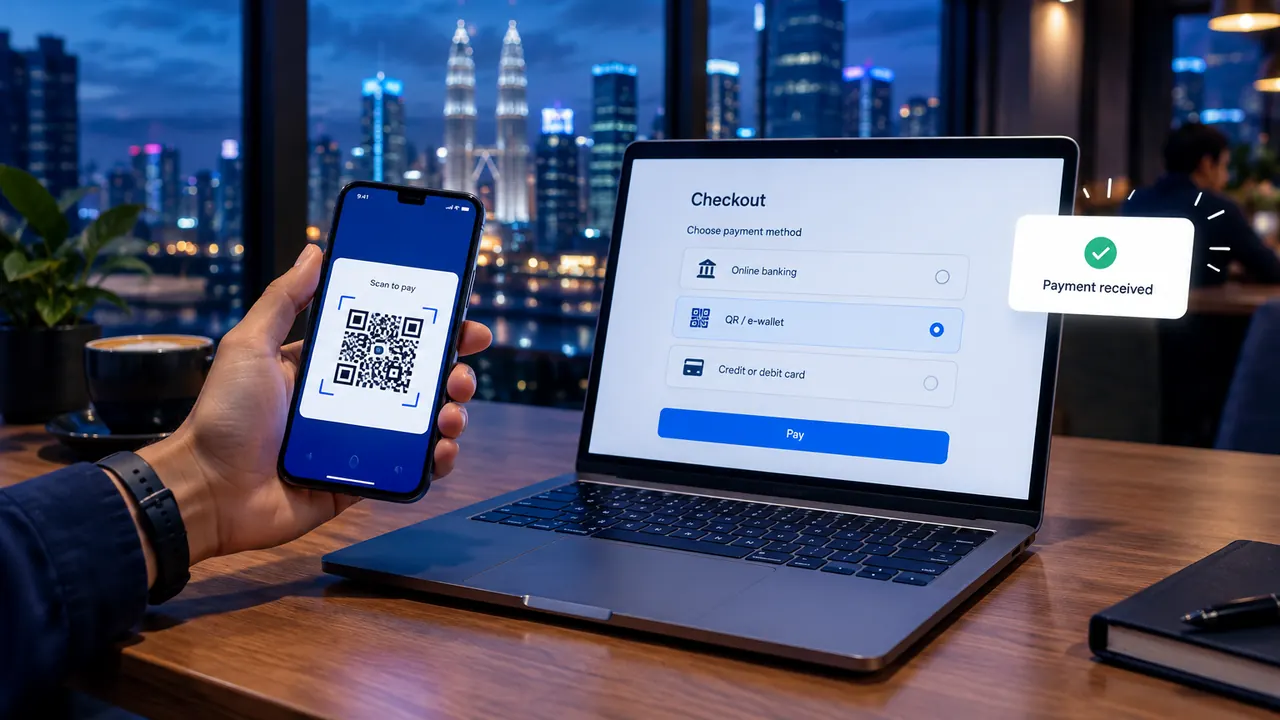
- Most Malaysian stores should offer FPX and cards at minimum, then add DuitNow QR and e-wallets for customers who pay by phone.
- You don't connect to FPX or DuitNow directly. A payment gateway gives you all of them through one integration.
- Choose the gateway on methods, settlement, refunds, recurring billing and how well it fits your platform, not on fees alone.
The short answer
For a business selling to Malaysian customers, the safest starting point is FPX plus debit and credit cards. FPX covers customers who prefer paying straight from their bank account, and cards cover everyone else, including overseas buyers and subscriptions.
If many of your customers buy on their phone, add DuitNow QR and the popular e-wallets such as Touch 'n Go eWallet, GrabPay, ShopeePay and Boost. A good payment gateway lets you switch these on together, so you rarely have to choose only one.
The right mix depends on who your customers are, how much they spend per order, and whether you bill once or every month. The sections below explain each option in plain terms.
FPX: pay from your online banking
FPX (Financial Process Exchange) is run by PayNet, Malaysia's national payments network. At checkout the customer picks their bank, is sent to that bank's online banking page, logs in and approves the payment. They then come back to your website with a success or failure result.
- Good for: local customers, larger one-off purchases, course and registration fees, deposits and invoice payments.
- Why customers like it: no card needed, and they approve the payment inside a bank they already trust.
- Watch out for: customers who leave the bank page before returning to your site. Your system must confirm the final status with the gateway server to server, not only from the browser redirect.
Many gateways also support FPX for business (corporate) bank accounts, which helps if you sell to other companies. Corporate accounts often need a second person to approve, so the payment may stay pending until that happens. Ask your gateway whether this is supported and how pending payments are reported.
DuitNow QR and e-wallets: pay with a phone
DuitNow QR is Malaysia's national QR code standard, also run by PayNet. One QR code can be scanned by participating banking apps and e-wallets, so you don't need a separate code for each wallet.
- On a desktop checkout, the customer scans the QR shown on screen with their phone and confirms in their app.
- On a mobile checkout, scanning your own screen is awkward. Check how your gateway handles this, for example by opening the customer's e-wallet app directly.
- Good for: younger and mobile-first customers, F&B ordering, events, small everyday purchases.
E-wallets such as Touch 'n Go eWallet, GrabPay, ShopeePay and Boost can also be offered as their own buttons through most gateways. Offering the wallets your customers already use reduces drop-off at the last step.
Debit and credit cards
Visa and Mastercard cards (and local debit cards) are still essential, for three reasons:
- Overseas customers. FPX and DuitNow are for Malaysian bank accounts. Buyers from Brunei, Singapore or further away will usually pay by card.
- Subscriptions and recurring billing. Cards can be saved securely by the gateway (tokenised) and charged automatically each month, which suits memberships, software subscriptions and maintenance plans.
- Customer habit. Some customers simply prefer cards, for example to earn rewards.
The trade-off is disputes. A cardholder can ask their bank to reverse a payment (a chargeback), so keep clear records: order details, delivery proof and your terms. Card payments are normally protected by 3-D Secure, where the bank asks the customer to confirm in their banking app or by one-time code.
Side-by-side comparison
| FPX | DuitNow QR / e-wallets | Cards | |
|---|---|---|---|
| How the customer pays | Logs in to their online banking | Scans or confirms in a banking or e-wallet app | Enters card details, confirms with 3-D Secure |
| Best for | Local customers, larger one-off payments, B2B | Mobile shoppers, small everyday purchases | Overseas buyers, subscriptions |
| Recurring billing | Not designed for automatic monthly charges | Not designed for automatic monthly charges | Yes, with saved (tokenised) cards |
| Needs a card | No | No | Yes |
| Main thing to plan for | Pending and abandoned bank sessions | Smooth flow on mobile checkouts | Chargebacks and disputes |
Fees, settlement times and refund rules differ between gateways and change over time, so compare current quotes in writing rather than relying on published blog figures.
Which mix suits your business?
- Online shop selling to Malaysians: FPX, cards, DuitNow QR and the main e-wallets. Also think about how your website stock syncs with Shopee, Lazada and TikTok Shop if you sell there too.
- Memberships, tuition or software subscriptions: cards for automatic monthly charges, with FPX as an option for customers who prefer to pay manually each cycle.
- B2B supplier or service company: FPX with corporate banking support, plus clear invoice references for bank transfers. Your invoices may also need to go through LHDN MyInvois.
- Restaurant, café or event: DuitNow QR and e-wallets first, with cards for tourists and corporate bookings.
- Clinic or service booking with deposits: FPX and cards for the deposit, with automatic WhatsApp or email confirmation once the payment is confirmed.
How to choose a payment gateway
You don't integrate FPX, DuitNow and Visa separately. A licensed payment gateway connects to all of them and gives your website one checkout. When comparing gateways, ask:
- Which methods are included? FPX (personal and corporate), DuitNow QR, which e-wallets, cards, and any buy-now-pay-later options.
- How fast is settlement to your business bank account, and is it daily or weekly?
- How do refunds work for each method, and can your team issue them from a dashboard or through the API?
- Is recurring billing supported with saved cards, and how are failed renewals retried?
- Does it fit your platform? Ready plugins for WooCommerce or Shopify, or a well documented API with webhooks and a sandbox for custom systems.
- What does onboarding need? Usually SSM registration documents, a business bank account and a live website with clear terms, refund policy and contact details.
- What are the full costs? Setup, monthly and per-transaction fees for each method, in writing.
Technical checklist before you go live
Payment bugs cost real money, so these are worth getting right on the first build:
- Confirm payments server to server. Mark an order paid only after your server receives and verifies the gateway's callback or webhook, not because the customer landed on a "thank you" page.
- Handle pending and failed states. Show the customer a clear message and let them retry without creating duplicate orders.
- Reconcile daily. Match gateway settlement reports with orders in your system or accounting software such as SQL Accounting or AutoCount.
- Keep card data off your server. Use the gateway's hosted payment page or secure fields so your website never stores card numbers.
- Connect e-invoicing. If you must issue e-invoices, generate them from the confirmed payment so the records match.
- Test everything in sandbox, including refunds, cancelled bank sessions and slow callbacks, before switching to live keys.
Brainiac Creation builds websites, apps and custom systems with FPX, DuitNow and Touch 'n Go payments, connected to accounting, e-invoicing and marketplace stock. See our web development and custom software services, or our page for e-commerce and retail.
Frequently asked questions
Is FPX the same as DuitNow?
No. Both are run by PayNet, but FPX is a redirect to the customer's online banking, while DuitNow QR is a national QR standard that customers scan or confirm in a banking or e-wallet app. Most gateways offer both.
Do I need a separate agreement with FPX, DuitNow and each e-wallet?
Usually not. A licensed payment gateway gives you FPX, DuitNow QR, e-wallets and cards through one account and one integration. You sign up with the gateway, not with each payment method.
Can customers pay by FPX every month automatically?
FPX is designed for one-off payments that the customer approves each time. For automatic monthly charges, use saved cards through your gateway, or ask the gateway what direct debit options it supports.
Which payment method has the lowest fees?
It depends on the gateway and your sales volume, and rates change. Ask two or three gateways for written quotes for each method you plan to offer, and compare settlement times and refund rules as well as the fee.
What documents does a gateway usually need?
Typically your SSM registration, a business bank account in the company's name, director details and a live website showing your products, prices, terms, refund policy and contact details. Each gateway sets its own list.
Can Brainiac Creation add payments to my existing website or system?
Yes. We integrate FPX, DuitNow and Touch 'n Go payments into websites, apps and custom systems, and connect them to tools such as SQL Accounting, AutoCount and LHDN MyInvois. Book a free consultation to discuss your setup.
Related
- Getting your system ready for LHDN MyInvois e-invoicing
- Custom CRM or off-the-shelf: which fits a Malaysian SME?
- Web development services
- E-commerce and retail software
Updated 2026-11-19 · The Brainiac team, Setia Alam
